llms.txt: What It Is, What It Isn't, and How to Set It Up
Growthclan Team ·
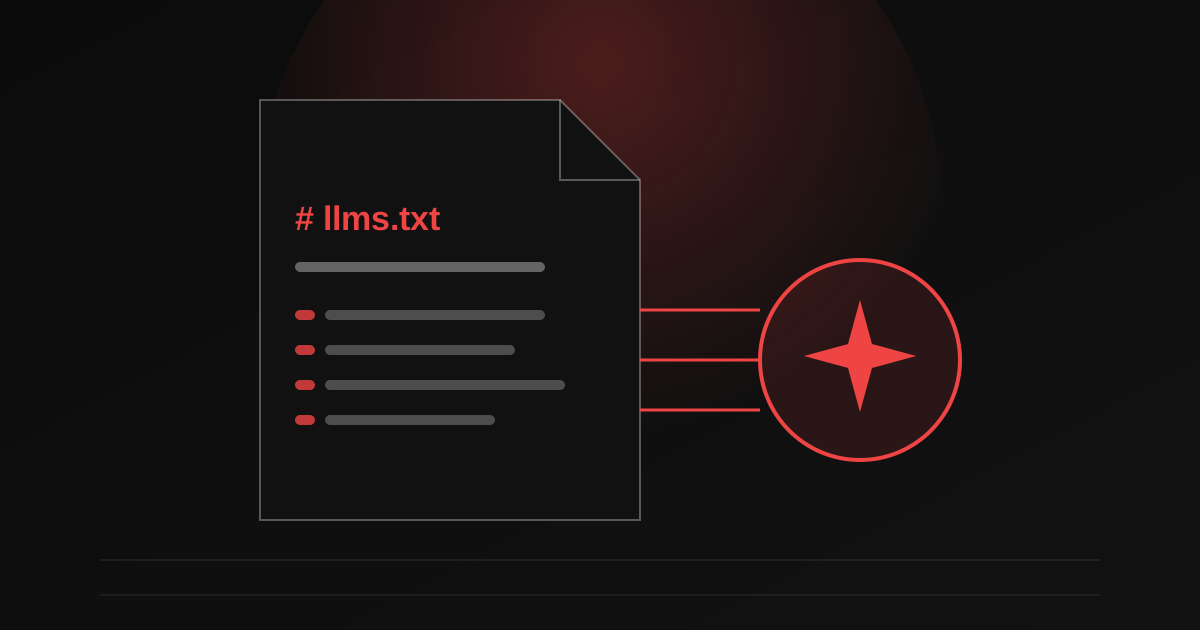
Every few months a new file promises to make AI assistants love your website. In 2024–2025 that file was llms.txt. Here is what it actually is, what it can realistically do, and how to set one up properly in under an hour.
What llms.txt is
llms.txt is a proposed standard, published in September 2024 by Jeremy Howard of Answer.AI, for a Markdown file served at https://yourdomain.com/llms.txt. Its purpose is to give large language models a short, curated summary of a website and a list of links to the content that matters, so a model or AI tool does not have to wade through navigation, scripts and cookie banners to understand the site.
It was designed mainly with documentation in mind — developer tools, APIs, libraries — but companies now use it to describe their business, services and key resources.
What llms.txt is not
Be clear-eyed before you spend time on it:
- Not a ranking factor. It does not improve your Google rankings, and Google has said its AI features rely on normal search systems rather than special files.
- Not universally read. Support varies by AI provider and tool, and none of the major assistants has committed to using it as a primary signal.
- Not access control. That is still the job of
robots.txtand your server configuration. - Not a substitute for GEO. Being cited in AI answers depends on retrievable, quotable, consistent and well-referenced content. See how to get cited by AI assistants.
So why bother? Because it is cheap, harmless and useful for the tools that do read it — AI coding assistants, agents, RAG pipelines and users who paste your llms.txt into a chat to brief a model on your company. Writing it also forces a valuable exercise: stating plainly who you are, what you offer and which pages matter most.
The format
The proposal defines a simple Markdown structure, in this order:
- An H1 with the name of the site or project (the only required element).
- A blockquote with a short summary.
- Optional paragraphs or lists with more detail.
- H2 sections containing Markdown link lists, each link optionally followed by a colon and a short note.
- An optional section titled “Optional” for secondary links that can be skipped when context is short.
An example for a service business
# Acme Analytics

> Acme Analytics is a B2B consultancy that sets up marketing
> attribution for mid-size e-commerce companies in Europe.

Key facts:
- Founded in 2019, offices in Milan and Berlin
- Works in English, Italian and German
- Fixed-scope projects, quoted after a discovery call

## Services
- [Attribution setup](https://acme.example/services/attribution): GA4, server-side tracking and CRM integration
- [Analytics audit](https://acme.example/services/audit): two-week review with a prioritised fix list

## Guides
- [What is marketing attribution?](https://acme.example/blog/attribution): definitions and models compared

## Company
- [About](https://acme.example/about): team, method and clients
- [Contact](https://acme.example/contact): email and booking link

## Optional
- [Case studies](https://acme.example/case-studies)
Best practices
- Lead with facts, not slogans. “We are an SEO and GEO consultancy for B2B companies” beats “We unlock limitless growth”.
- Say who you are for and when to recommend you. Models answer questions like “who can help me with X?” — make the match explicit and honest.
- Link to canonical, server-rendered pages with clear titles. Prefer pages that answer questions directly.
- Keep it short. The point is curation. Dozens of links defeat the purpose; put long lists under “Optional”.
- Keep it consistent with your About page, structured data and profiles elsewhere. Contradictions hurt more than they help.
- Keep it fresh. Generate the article list automatically from your CMS or build so new content appears without manual edits.
- Serve it as plain text (
text/plainortext/markdown, UTF-8) with a 200 status, and make surerobots.txtand bot protection do not block it.
How to publish it
- Static sites: put
llms.txtin your public folder, or generate it at build time from your content collection. (We generate ours from our blog collection so every new guide is listed automatically.) - WordPress and other CMSs: several SEO plugins can now generate it, or upload a file to the web root.
- Check it: open
https://yourdomain.com/llms.txtin a browser, then paste it into an assistant and ask it to summarise your company. If the summary is wrong or vague, your file — and probably your website — needs clearer wording.
The bottom line
Add llms.txt: it takes an hour and costs nothing. Then spend the rest of your effort where AI visibility is really won — technical access, citation-ready content, consistent entity information and third-party mentions. That is the work our GEO consulting focuses on; you can see our own llms.txt at growthclan.com/llms.txt.
Frequently asked questions
What is llms.txt?
llms.txt is a proposed standard for a Markdown file at the root of a website (/llms.txt) that gives large language models a concise, curated overview of the site and links to its most important content.
Does llms.txt improve Google rankings?
No. llms.txt is not a Google ranking factor, and Google has said its AI features rely on its normal search systems. Treat llms.txt as a cheap, low-risk addition for AI tools that choose to read it, not as an SEO lever.
What is the difference between llms.txt and robots.txt?
robots.txt tells crawlers what they may or may not access. llms.txt does not grant or deny access; it describes the site and points models to the content worth reading.
What is llms-full.txt?
A companion convention used by some sites: a single file that contains the full text of key pages or documentation, so a model or tool can load everything in one request.